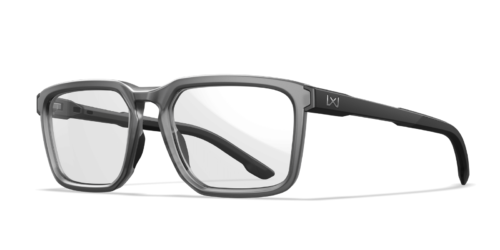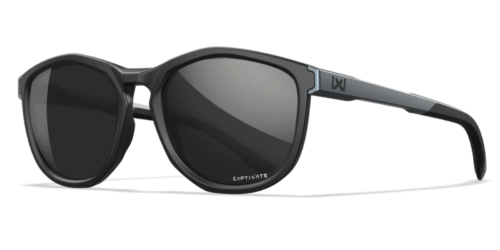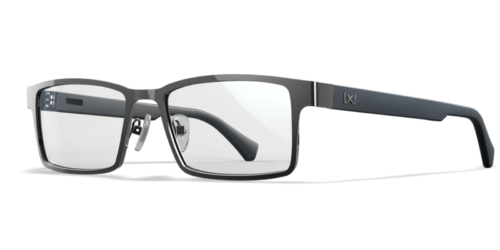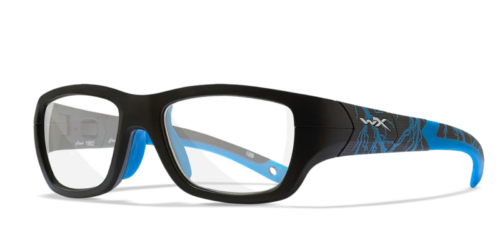
Short answer: no. Regular prescription glasses are not safety glasses, and the gap is bigger than most people think. This post explains what the difference actually is, what qualifies, and the three ways to get real protection if you need a prescription to see.
Why everyday glasses do not count
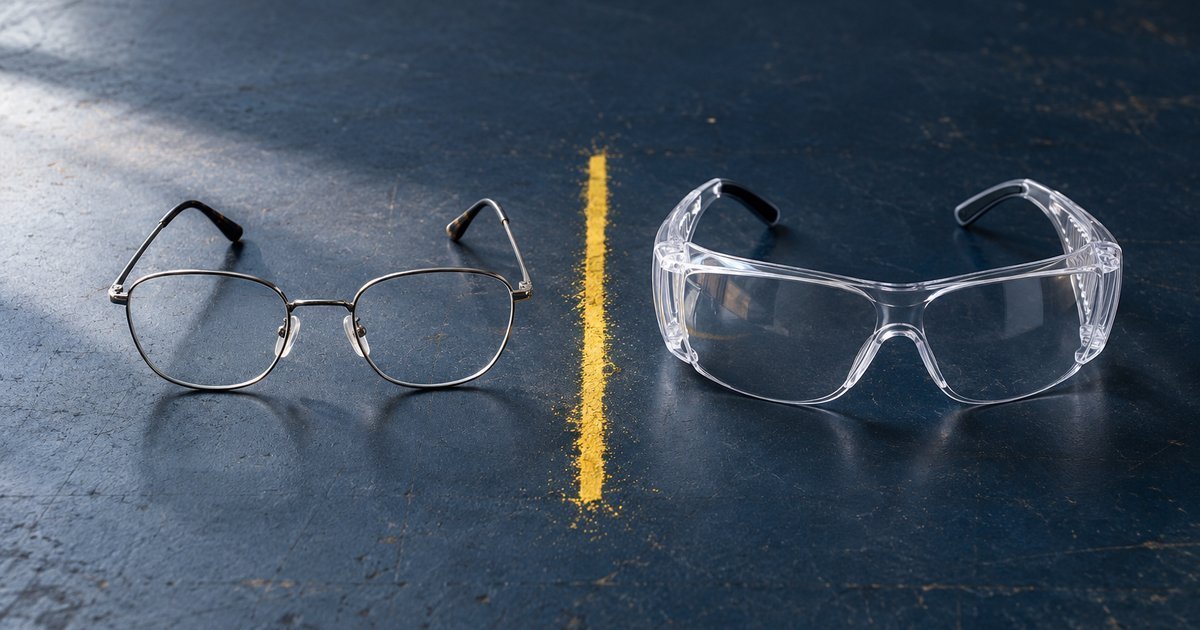
Dress eyewear and safety eyewear are built to different rules and tested in different ways.
- The lens test is different. Everyday lenses sold in the United States must pass the FDA drop-ball test (21 CFR 801.410), a 5/8-inch steel ball dropped from 50 inches onto the lens. It proves the lens is impact-resistant, not that it will stop something flying at it. A Z87+ safety lens must survive a quarter-inch steel ball at 150 feet per second and a 500 g pointed weight dropped from about 50 inches, in the frame.
- The frame is untested. Dress frames are designed for weight and looks. Nobody tests whether the lens stays in the frame under impact, or whether the frame itself shatters. Safety frames are tested as an assembly and the lens must stay put.
- There is no side protection. Most eye injuries at work come from particles arriving from the side or below. Dress frames leave that open; safety frames add side shields or wrap around the face.
- There is no marking. A compliant protector is permanently marked Z87 or Z87+ on frame and lens. No marking, no rating.
Polycarbonate lenses are the usual source of confusion. Polycarbonate is the material most safety lenses are made from, so people assume a polycarbonate dress lens is a safety lens. It is not; the rating belongs to the tested product, not to the material.
What OSHA says about people who wear glasses
OSHA’s eye protection rule, 29 CFR 1910.133(a)(3), is written specifically for prescription wearers. Anyone exposed to eye hazards who wears prescription lenses must use eye protection that either incorporates the prescription in its design, or can be worn over the prescription glasses without disturbing the position of either pair. Regular glasses alone fail both halves of that sentence. Our guide to OSHA approved prescription safety glasses covers the rest of the rule, including who pays.
What actually qualifies
Three things, all at once:
- Tested to ANSI/ISEA Z87.1, the standard OSHA requires.
- Permanently marked Z87 (basic) or Z87+ (high impact) on the frame and on each lens. For prescription eyewear, the frame and lenses carry Z87-2 or Z87-2+.
- Side protection wherever flying objects are a hazard, either moulded into the frame or as fitted shields.
The markings are explained in detail in our post on Z87 vs Z87+ vs Z87.1. The short version: look for the plus sign for any job with flying particles.
The three compliant routes if you need a prescription
1. Prescription safety glasses
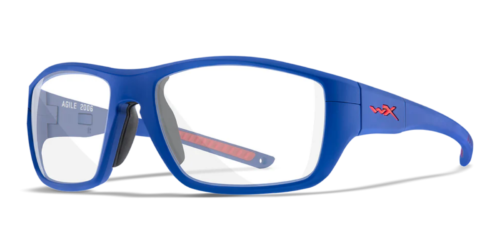
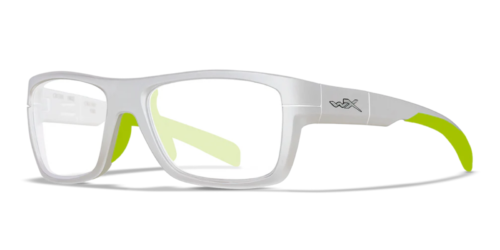
A rated safety frame with your prescription made into rated lenses. This is the route that works for all-day wear, because it is one pair of glasses: you see with it and you are protected by it. Every frame in our prescription safety glasses range is a Z87-2 frame, and the Select Lens button on the product page adds single vision or progressive lenses to the same standard, and bifocals on flat frames.
If the objection is looks, the frames have moved on. Stoggles are Z87.1 rated and look like ordinary square or round glasses; the Guardian SafetyRx GRXS01 and the ArtCraft WF963FF are metal frames that pass as everyday eyewear with their shields removed, and carry the shields when you are on the floor. For a wrap style, the Pentax ZT400 is the one most job sites know.
2. Fitover safety glasses or goggles over your glasses
Large-lens safety glasses or sealed goggles designed to sit over regular glasses. They are compliant when they fit properly, cheaper for occasional use, and the only route for people who cannot get a safety prescription quickly. The trade-offs are weight, fogging between two sets of lenses, and fit on larger frames. Our fitover guide compares the options, and the safety goggles category has sealed styles such as the Pentax GT20 that can be glazed with a prescription instead.
3. Clip-on side shields, but only on a rated frame
This is the shortcut people hope will rescue their everyday glasses, and it does not. Side shields only add protection to a frame that is already rated; OSHA allows detachable shields on compliant eyewear, not as a way to make non-compliant eyewear compliant. Where they do earn their keep is on a rated frame that came without shields or has lost them, which is why we stock model-specific side shields for Pentax, Hudson and ArtCraft frames.
Regular glasses vs safety glasses at a glance
| Everyday prescription glasses | Prescription safety glasses | |
|---|---|---|
| Lens test | FDA drop-ball (5/8-inch ball, 50 inches) | Z87.1 high-mass and high-velocity impact, in the frame |
| Frame | Untested; designed for weight and style | Tested as an assembly; lens must stay in the frame |
| Side protection | None | Moulded or fitted side shields, or wrap design |
| Marking | None | Z87-2 / Z87-2+ on frame and lenses |
| Meets 1910.133(a)(3)? | No | Yes |
| Can be worn off site | Yes | Yes, which is why employers often allow it |
How to choose, in two minutes
- Daily hazard exposure: prescription safety glasses. Choose Z87+ with side shields; add a foam seal if dust is the problem.
- Occasional exposure, or waiting for a prescription: fitovers or goggles over your glasses.
- Your employer specifies a frame: check the product page for the markings it requires, then add your prescription with Select Lens.
- Not sure of your size: read how to read glasses measurements and compare with a pair you own, or use the virtual try-on on the product page.
Ordering online without trying frames on is easier than it sounds; our guide on how to buy prescription safety glasses online walks through fit, prescription entry and returns.
Shop the picks
-
 Artcraft WF963FF$65.95
-

-
 Pentax ZT400 Safety Glasses$57.00
-

Frequently asked questions
Can regular prescription glasses be used as safety glasses?
No. Everyday glasses are not tested as a complete protector, their frames are not impact rated, they have no side protection, and they carry no Z87 marking. OSHA’s rule for prescription wearers (1910.133(a)(3)) requires either safety glasses that incorporate the prescription or protection worn over the regular glasses.
What qualifies as safety glasses?
Eyewear that has been tested to ANSI/ISEA Z87.1 and is permanently marked Z87 or Z87+ on both the frame and the lenses, with side protection where flying objects are a hazard. For prescription wear, the frame carries Z87-2 and the lenses are made to the same standard.
Do polycarbonate lenses make my glasses safety glasses?
No. Polycarbonate is the usual material for safety lenses, but the rating belongs to the tested, marked product, not the material. A polycarbonate dress lens in an untested frame is still not rated.
Can I put clip-on side shields on my regular glasses?
You can, but they do not make the glasses compliant. Side shields only count on a frame that is itself rated to Z87.1. On a rated frame, detachable shields are explicitly allowed by OSHA.
Do I have to wear safety glasses if I wear glasses?
Yes, if your job involves eye hazards. The two compliant options are prescription safety glasses, or fitover safety glasses or goggles worn over your regular pair.