Every pair of safety glasses sold in the United States carries a short string of letters and numbers on the frame and the lens. Those marks are the only proof that the eyewear was tested, and they tell you exactly what it was tested against. This guide decodes them, starting with the three everyone asks about: Z87, Z87+ and Z87.1.
Z87.1 is the standard; Z87 and Z87+ are the marks
ANSI/ISEA Z87.1 is the American National Standard for occupational eye and face protection, written by the International Safety Equipment Association and approved by ANSI. The current edition is Z87.1-2020. It sets the tests a protector has to pass and the marks it must carry afterwards.
Z87 on a frame or lens means the product meets the standard’s basic requirements: optical quality, coverage, and a drop-ball impact test on the lens. Z87+ means the product also passed the standard’s two high-impact tests, which are much tougher. The plus sign is the single most useful thing to look for, because almost every workplace hazard involves something flying at the eye.
So “Z87 vs Z87.1” is not a comparison of two products. Z87.1 is the name of the rulebook; Z87 and Z87+ are the grades written on the glasses.
The two high-impact tests behind the plus sign
To earn Z87+, a protector is tested as a complete assembly, frame and lens together, and must not crack, chip, or let the lens come out of the frame:
- High-mass impact. A 500 g (17.6 oz) pointed projectile is dropped onto the lens from a height of about 50 inches (1.3 m).
- High-velocity impact. A 6.35 mm (quarter-inch) steel ball is fired at the lens at 150 ft/s (45.7 m/s) for spectacles. Goggles are tested at 250 ft/s and face shields at 300 ft/s.
Basic Z87 protectors face only a lighter drop-ball test on the lens. That is why a basic-rated frame can be legal for, say, an office lab with a splash risk but is the wrong choice for grinding, chipping, framing, or any work where particles move fast.
Z87-2: the mark for prescription safety glasses
This is the one that trips people up. When you search for “Z87.1 vs Z87.2” you are really looking at Z87-2, a marking, not a standard. It is stamped on prescription (Rx) lenses that meet Z87.1, and on frames designed to hold them. Z87-2+ means the prescription lens passed the high-impact tests. The frame carries its own mark, so a complete pair of prescription safety glasses shows Z87-2 (or Z87-2+) on the frame and on each lens.
Every frame in our prescription safety glasses range is a rated Z87-2 frame, and the lenses we make for it are cut to the same standard. The product page for each frame, for example the Pentax ZT400 or the ArmouRx 7003, lists the exact markings that frame carries.
The full marking decoder
Beyond impact, the standard uses letters for the other hazards a protector is rated against. You will often see several together, such as Z87+ W5 U6.
| Mark | What it means | Where you see it |
|---|---|---|
| Z87 | Meets ANSI/ISEA Z87.1 basic requirements | Frame and lens of all compliant eyewear |
| Z87+ | Passed high-mass and high-velocity impact tests | Frame and lens; the mark to look for on job sites |
| Z87-2 | Prescription (Rx) lens or frame meets the standard | Frame and Rx lenses |
| Z87-2+ | Prescription lens passed the high-impact tests | Rx lenses in a Z87-2 frame |
| D3 | Tested for droplet and splash protection | Goggles and sealed frames used around liquids |
| D4 | Tested for dust protection | Sealed goggles |
| D5 | Tested for fine dust protection | Sealed goggles |
| W + number | Welding filter, with the shade number (W3, W5, W10) | Welding and cutting lenses |
| U + number | Ultraviolet filter, scale 2 to 6 (U6 is the strongest) | Most tinted and many clear lenses |
| R + number | Infrared filter and scale | Furnace and foundry lenses |
| L + number | Visible light filter and scale | Specialty tints |
| V | Variable tint (photochromic) lens | Transition-style safety lenses |
| S | Special-purpose lens tint | Tints that do not fit the other filter categories |
| H | Sized for smaller heads | Frames cut for narrow faces |
| X | Anti-fog coated lens | Lenses with a coating that passed the fog test |
Two details matter when you read these. First, the impact rating and the filter rating are separate: a W5 welding lens can be Z87 or Z87+. Second, a mark on the lens does not cover the frame. For a complete high-impact protector both parts must be marked, which is why a replacement lens from another maker can quietly downgrade a pair.
How Z87+ compares with other ratings
If you work across borders or shop military-style eyewear you will meet three other systems:
- CSA Z94.3 is the Canadian standard. Many industrial frames, including most of our ArmouRx frames, carry both Z87+ and CSA Z94.3, so one pair satisfies programs on either side of the border.
- EN 166 is the European standard, with its own impact grades (F, B and A). It is not interchangeable with Z87; a European frame needs its own Z87 test to be sold as compliant here.
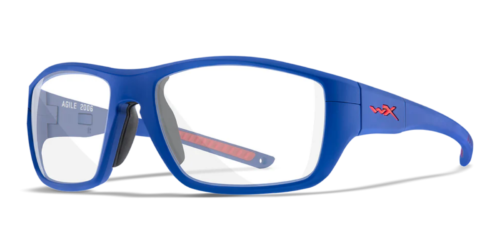
- MIL-PRF-32432 is the U.S. military ballistic fragmentation standard, tougher than Z87+. Spectacles are tested with a 0.15-caliber projectile at roughly 650 ft/s, and goggles with a 0.22-caliber projectile at roughly 550 ft/s. Several Wiley X tactical frames, such as the Saber Advanced and the Axe, carry both Z87+ and the military rating.
What OSHA actually asks for
OSHA’s eye and face protection rule, 29 CFR 1910.133, requires protection that meets ANSI Z87.1 and is appropriate for the hazard found in the employer’s assessment. The rule names the 2010, 2003 and 1989 editions, and OSHA has accepted eyewear made to newer editions because they offer equal or better protection. The rule does not say “Z87+” anywhere; the plus comes from the hazard assessment, because flying-particle hazards call for the high-impact grade. Our OSHA approved prescription safety glasses page covers the rule in more detail.
Which rating should you buy?
- Construction, manufacturing, metalwork, woodworking, grinding, auto repair: Z87+ on frame and lens, with side shields. Add D3 if you also handle liquids.
- Laboratory, healthcare, cleaning, chemical handling: Z87+ plus D3 splash rating, or a sealed goggle with D3 and D4.
- Welding and cutting: Z87+ with the W shade your process needs; the shade table in 1910.133 lists minimum numbers by amperage.
- Shooting, hunting, tactical: Z87+ at minimum; MIL-PRF-32432 if you want ballistic-grade.
- Everyday prescription wear that doubles as PPE: a Z87-2 frame with Z87-2+ lenses, so the pair you wear all day is the pair that protects you.
If you need to find a frame by its rating, start with the Z87 certified safety glasses collection, the D3, D4 and D5 rated frames, or browse by brand: Pentax, OnGuard, Hudson Optical and Wiley X. Every product page lists the markings, the side-shield type and the prescription options, and the Select Lens button adds your prescription to the frame you choose.
Shop the picks
-
 Wiley X Axe$216.00
-
 Pentax ZT400 Safety Glasses$57.00
-
 ArmouRx 7003 Safety Glasses$65.00
-

Frequently asked questions
What is the difference between Z87 and Z87+?
Both marks come from the same standard, ANSI/ISEA Z87.1. Z87 means the protector meets the basic requirements. Z87+ means it also passed the two high-impact tests: a 500 g pointed weight dropped from about 50 inches and a quarter-inch steel ball fired at 150 feet per second. For anything involving flying particles, choose Z87+.
What does Z87.1 vs Z87.2 mean? Is there a Z87.2 standard?
There is no Z87.2 standard. The marking people see is Z87-2, which is stamped on prescription (Rx) lenses that meet the standard. Z87-2+ means the prescription lens passed the high-impact tests. The standard itself is always Z87.1.
Does OSHA require Z87+ or is Z87 enough?
OSHA’s rule (29 CFR 1910.133) requires eye protection that meets ANSI Z87.1 and is appropriate for the hazard. It does not say Z87+ by name. In practice, employers specify Z87+ wherever a hazard assessment lists flying particles, because the basic Z87 rating is not tested against them.
Do all safety glasses have to be stamped Z87?
Yes. Compliant eyewear is permanently marked with the manufacturer’s mark and Z87 (or Z87+) on the frame and on each lens. If you cannot find the marking, treat the eyewear as unrated.
Are prescription safety glasses Z87+?
They can be. The frame must carry Z87-2 (or Z87-2+) and the lenses must be made to the same standard by the lab. Every prescription frame on this site is rated; the product page lists the exact markings for that frame.